
Key Points
-
Europe’s first NuScale SMR is a big step, but with a 7-year timeline, meaningful revenue is still years away.
-
NuScale isn’t just replacing traditional reactors, it’s competing with solar-plus-storage, which is already faster and often cheaper to deploy.
-
If NuScale delivers multiple projects, it could deliver hundreds of millions of dollars in revenue, but that outcome hinges on execution and adoption.
- These 10 stocks could mint the next wave of millionaires ›
This could ultimately be one of the biggest disruptions the global energy economy has seen in decades: Europe’s first operational small modular nuclear reactor (SMR), which will be using NuScale Energy‘s (NYSE: SMR) SMR technology.
This particular SMR project is a 426-megawatt facility that’s expected to come online in about 7 years. While this may seem like a long time, a traditional nuclear power plant can take up to 15 years.
Will AI create the world’s first trillionaire? Our team just released a report on the one little-known company, called an “Indispensable Monopoly” providing the critical technology Nvidia and Intel both need. Continue »
That being said, smart investments can’t be built on promises alone. Here’s why investors may want to tread carefully with NuScale Energy’s stock
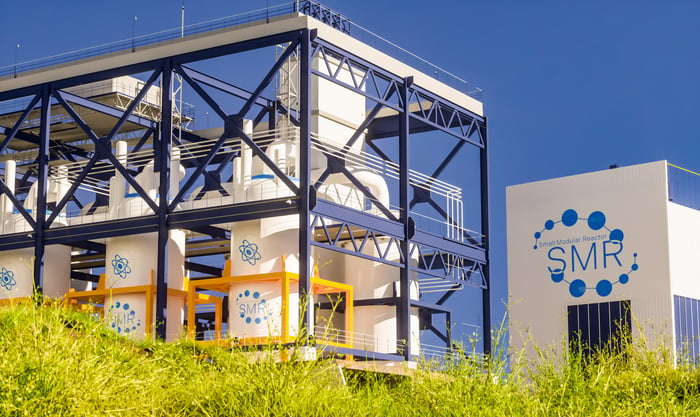
Image source: Getty Images.
Cost matters
If you’re unfamiliar, an SMR is a smaller, factory-built nuclear reactor that can be shipped and assembled on-site. Each unit produces less power than traditional reactors but can be scaled by adding modules.
Of course, a traditional nuclear reactor can also generate more than twice what this particular SMR is expected to produce. But to be fair, this is still relatively new technology, and the promise of expedited timelines, attractive safety profile, and cost reductions is not without merit particularly as we enter an era of rising global electricity demand.
While it can be argued that SMR technology is the next evolution of nuclear power due to its safety, environmental, and cost advantages, it’s not just competing against traditional nuclear power. It’s competing against all forms of power production. And this is a detail that should not get lost in any honest conversation about SMRs.
This is particularly true for solar-plus-battery storage.
Current estimates put NuScale’s SMR electricity costs at between $89 to $102 per megawatt-hour (MWh). By contrast, solar-plus-battery storage typically comes in at around $66 to $92 per MWh on a levelized basis, also referred to as levelized cost of energy (LCOE). That is, the total cost of producing electricity averaged out over the entire life of a project.
The LCOE also includes operations and maintenance, as well as battery replacement after about 10 to 15 years. The result is a cost structure that is not only lower in many cases but also more predictable, as it avoids the long-duration financing risk embedded in SMR projects.
This doesn’t mean SMRs, particularly those built by NuScale, won’t fall in price over time and completely change the math. They probablywill. But today, as artificial intelligence (AI) and data center demand are pressuring power producers to increase supply at an unprecedented pace, long timelines and prohibitive construction costs are not favorable.
Aside from a few behemoth tech giants, such as Amazon, Google, and Microsoft , which simply have the funds to support the early development of SMRs, in the near term, this is an investment opportunity only for those who are not risk averse and of course, don’t mind waiting patiently for a potential payout.
Revenue vs. cost structure
NuScale is generating very limited revenue relative to its cost structure.
For the full year 2025, the company reported $31.5 million in revenue. And that revenue came primarily from engineering services, government contracts, and early-stage project work.
Meanwhile, NuScale reported a net loss of approximately $664 million in 2025.
Cash flow tells the same story. The company is running significant negative free cash flow, with operating cash outflows of roughly -$460 million in 2025, reflecting ongoing spending to advance projects that won’t generate revenue for years.
With first commercial projects not expected to produce power until the early 2030s, the company may need multiple additional funding rounds before it becomes cash flow positive. This is a risk investors should not overlook.
Of course, NuScale’s technology shouldn’t be trivialized, either. Yes, the timing and funding obstacles are very real. But the truth is, if NuScale can make this work, it could become a mid-margin, billion-dollar revenue industrial technology company.
You see, each SMR plant represents a multibillion-dollar build, and while NuScale doesn’t capture the full project value, it earns revenue from engineering, licensing, and long-term services.
Based on that model, even a handful of global deployments could translate into hundreds of millions per project, assuming multiple projects are operating simultaneously.
Make no mistake: NuScale is not one to ignore, but this should definitely be considered a long-term investment for those who aren’t particularly risk-averse and have plenty of patience.
Where to invest $1,000 right now
When our analyst team has a stock tip, it can pay to listen. After all, Stock Advisor’s total average return is 971%* — a market-crushing outperformance compared to 202% for the S&P 500.
They just revealed what they believe are the 10 best stocks for investors to buy right now, available when you join Stock Advisor.
*Stock Advisor returns as of May 1, 2026.
Jeff Siegel has no position in any of the stocks mentioned. The Motley Fool has positions in and recommends Alphabet, Amazon, and Microsoft. The Motley Fool recommends NuScale Power. The Motley Fool has a disclosure policy.
5 Stocks Our Experts Predict Could Double In the Next Year
By submitting your email, you'll also get a free pivot & flow membership. A free daily market overview. You can unsubscribe at any time.