
Key Points
-
General Motors stock is trading at more than twice what Warren Buffett paid for it in 2017.
-
The automaker is coming off a difficult year financially, as it took a multibillion-dollar write-down on its slowing EV business.
-
GM recently raised its dividend and authorized a large share buyback.
- 10 stocks we like better than General Motors ›
In the second quarter of 2017, Warren Buffett, then the CEO of Berkshire Hathaway (NYSE: BRKB), made a somewhat contrarian bet, having the conglomerate buy 10 million shares of General Motors (NYSE: GM) at an average closing price of $33.95. At the time, that move increased Berkshire’s stake in the automaker by 20%.
Will AI create the world’s first trillionaire? Our team just released a report on the one little-known company, called an “Indispensable Monopoly” providing the critical technology Nvidia and Intel both need. Continue »
Buffett liquidated his position in the company in 2023, when its shares were trading at $35.59. That wasn’t a big score, relatively speaking. But what if Berkshire Hathaway had held onto those shares?
Today, GM is trading at more than $80 a share, and if you had bought the stock in 2017 and reinvested its dividends, your total return would be 159.4%. Now that’s a payday.
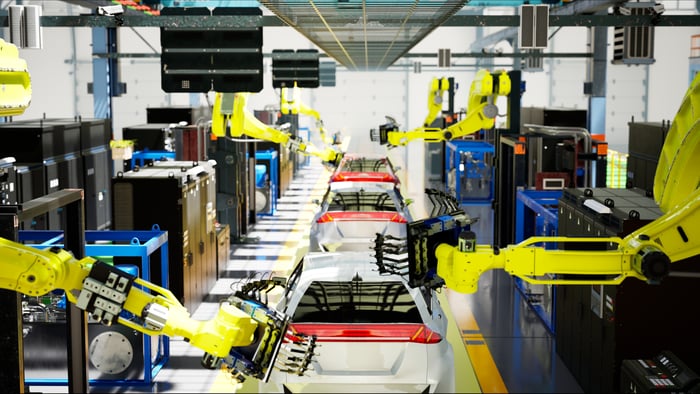
Image source: Getty Images.
How is GM doing now, though?
General Motors reported revenue of $185 billion in 2025, down 1.3%. Its earnings per share (EPS) declined even further, by 48.7%, to $3.24. Those numbers, though, were somewhat distorted by a fourth-quarter $7.2 billion write-down relating to the slowdown in its electric vehicle (EV) business. Most of those costs are the result of GM ending or restructuring contracts with suppliers in light of the fact that its EV sales are no longer growing at the rate it expected them to.
However, the company remains a solid dividend stock, despite those declines. In conjunction with its Q4 earnings report, it raised its quarterly dividend payout by 20% to $0.18 per share, and announced a $6 billion stock repurchase authorization.
The impacts of President Donald Trump’s tariffs, as well as a slowdown in EV sales after his Big Beautiful Bill ended the tax break that American buyers had enjoyed on those vehicles, have forced the automaker to adjust. However, it says it expects 2026 EPS of between $11 and $13, a huge jump from the $3.27 it booked in 2025, and a fairly solid improvement from its adjusted EPS of $10.60. It’s also guiding for adjusted earnings before interest and taxes of $13 million to $15 billion, compared to $12.7 billion in 2025.
Because the Trump administration rolled back auto emissions standards, carmakers can focus on higher-margin gas-powered vehicles again and reduce their financial exposure to EVs, which explains some of GM’s optimism.
Less appealing as an income stock
Are the risks of buying GM today worth it for its dividend? Not really, if you look at the numbers. The yield is a low 0.9% at the current share price, though it’s relatively safe given the company’s payout ratio of 37%. However, you don’t have to look very far to see that GM slashed its dividend by 76.3% in 2022 amid a period of weaker sales due to the pandemic. The automotive sector is notoriously cyclical. Automakers have a lot of fixed costs, so when sales slump, it isn’t easy for them to cut costs to maintain their margins.
The majority of the company’s write-offs related to its EV business are likely in the rearview mirror, which is why it could soon return to greater profitability. The difficulty I see, though, is that its annual revenues have only grown by a total of 24% over the past decade, while its annual EPS has fallen by more than 45%.
The company’s shares may be inexpensive, though, compared to its longtime Detroit competitors. GM is trading at around 6.2 times expected forward earnings, marginally less than Chrysler parent Stellantis‘ (NYSE: STLA). 6.5 and comfortably below Ford Motor Company‘s (NYSE: F) 8.7.
Should you buy stock in General Motors right now?
Before you buy stock in General Motors, consider this:
The Motley Fool Stock Advisor analyst team just identified what they believe are the 10 best stocks for investors to buy now… and General Motors wasn’t one of them. The 10 stocks that made the cut could produce monster returns in the coming years.
Consider when Netflix made this list on December 17, 2004… if you invested $1,000 at the time of our recommendation, you’d have $523,599!* Or when Nvidia made this list on April 15, 2005… if you invested $1,000 at the time of our recommendation, you’d have $1,118,640!*
Now, it’s worth noting Stock Advisor’s total average return is 951% — a market-crushing outperformance compared to 194% for the S&P 500. Don’t miss the latest top 10 list, available with Stock Advisor, and join an investing community built by individual investors for individual investors.
*Stock Advisor returns as of March 3, 2026.
James Halley has positions in Ford Motor Company. The Motley Fool has positions in and recommends Berkshire Hathaway. The Motley Fool recommends General Motors and Stellantis. The Motley Fool has a disclosure policy.
5 Stocks Our Experts Predict Could Double In the Next Year
By submitting your email, you'll also get a free pivot & flow membership. A free daily market overview. You can unsubscribe at any time.