
The same mistakes that crushed dot-com portfolios are happening again.
Hello, Reader.
One of the main keys to being a smart investor is to avoid staying comfortable and instead adapt to shifting currents – a principle that’s especially relevant in today’s market.
If you don’t believe me, listen to Bob Dylan:
You better start swimmin’ or you’ll sink like a stone,
For the times they are a-changin’.
The times certainly are “a-changin” when it comes to artificial intelligence.
AI is advancing at lightning speed, entering a huge shift away from those useful but ultimately limited chatbots, and towards autonomous systems capable of completing tasks on their own, without human input.
I’m calling this new technology “A-AI.”
And we’ve seen how rapid and disruptive it is. Anthropic’s recent, powerful model releases have already sparked the kind of software-sector volatility that signals a turning point.
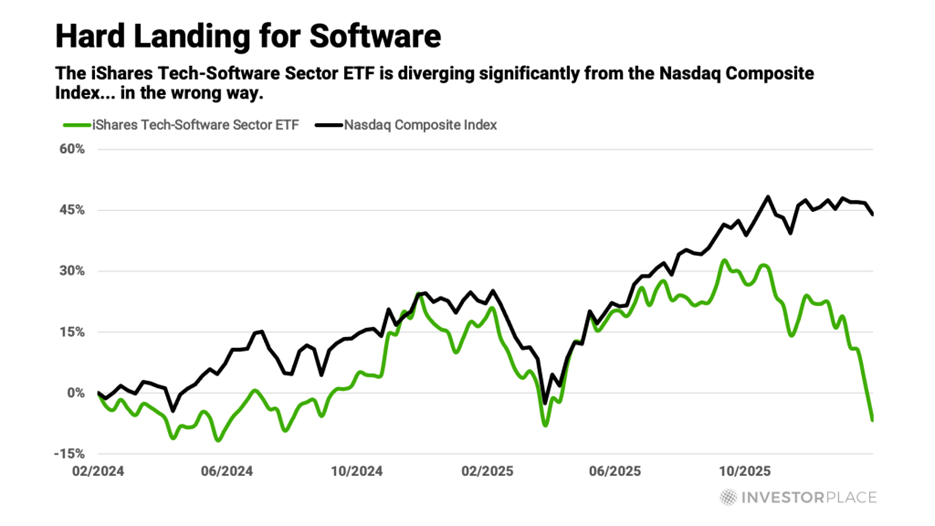
The iShares Expanded Tech-Software Sector ETF (IGV) – which tracks North American software firms, heavily weighted toward large-cap leaders – dropped steeply in February when plug-ins from Anthropic’s AI system, Claude Cowork, were released. And with Claude Mythos unveiled in April, turbulence in the sector has continued.
The ETF is now down over 20% year-to-date.
A-AI will only continue to encroach on our lives. There’s not much we can do about that. But we can prepare our portfolios accordingly.
Market shifts tend to trigger three common mistakes every time a breakthrough technology emerges. Millions of portfolios will suffer losses because of them.
So, in this issue, I’ll break down each costly mistake and show you how to stay on the right side of this technology transition. Then, I’ll share the action you need to take now.
Let’s jump in…
Mistake No. 1: Panic Sell
Time and time again, I’ve observed how market shifts can panic investors out of stocks altogether, leaving them to miss out on substantial returns.
Take eBay Inc. (EBAY) during the dot-com bust. When the bubble burst, panic spread through every corner of the tech market. Instead of investors stopping to ask whether a company’s business model was actually broken, they just sold.
eBay was caught in that wave.
Those who held on to the stock were rewarded with a 325% return between 2001 and 2003. It was eBay’s e-commerce operations, its capacity to profit from the internet, that maintained its status as a solid investment.
Of course, it’s important to sell shares when the time is right; but when uncontrollable forces move the markets, your best weapon is to control what you can.
That means to stay calm, strategic, and, thereby, profitable.
Mistake No. 2: Holding On to “Sells”
While you don’t want to panic sell, you also don’t want to hold on to doomed companies past their prime.
During the dot-com boom when the internet was vibrant and new – and Cisco Systems Inc. (CSCO) was soaring to great heights – many investors staked their claim company. Their optimism often blinded them to the inevitable risks of a decline.
The company was working on telecommunications, hardware, and software equipment – the fundamental components of the internet. Cisco was a key “Builder” in the new world of cyberspace.
Eventually, though, the appliers of the internet, like Amazon.com Inc. (AMZN), started gaining on the Builder companies. They eventually overtook them.
Cisco dropped 80% after the dot-com bubble burst and only recently surpassed its 2000 peak 25 years later. An investor who purchased at the peak, or slightly before it and held on, would have seen their significant gains disappear, resulting in over a decade of waiting just to break even.
So, despite its monumental role in creating the internet, the Builders got left behind. And investors that held on too long saw significant losses.
Given the current landscape of the AI market, I believe today’s AI Builders will face similar disadvantages.
So, don’t let the comfort of high-flying names fool you, or you might overlook one of the greatest moneymaking opportunities in history…
Mistake No. 3: Missing Opportunity
The Builders of this AI era – familiar faces like chipmaker Nvidia Corp. (NVDA) – have been the market darlings for the past few years. However, Nvidia and other Magnificent Seven stocks may soon forfeit their reign.
I believe we’ll see a changing of the guard that favors different, more lowly valued sectors. The companies applying AI, not building it. This is the new opportunity you don’t want to miss.
And it’s why I believe holding on to Nvidia could be one of the most expensive mistakes an investor can make during a technological turning point.
As A-AI becomes more powerful, tomorrow’s gains will go to companies that skillfully use it in their businesses and thrive, much as Amazon did after the dot-com bust.
Many of the high-profile tech companies that are falling right now may not recover for years… or ever. That’s because these companies are facing the serious existential threat of A-AI, which could replace them permanently or damage them beyond repair.
Buying the dip on those stocks would be like buying the dip on Blockbuster the year Netflix Inc. (NFLX) showed up.
Millions of Americans are about to make the classic mistake of assuming the winners of the recent past will also be the winners of the future. Sometimes that’s true. But it is rarely true when a genuinely disruptive technology emerges and reshuffles the market.
Today, we’re in one of, if not the most, consequential technological shifts in history.
And the investors who treat this moment like any other market cycle will be the most caught off guard.
The Bottom Line
The framework here is simple:
Don’t panic out of sound positions when external forces rattle the market. Instead, stay patient in companies that offer a compelling risk-reward profile.
Don’t cling to the AI Builders when the AI Appliers are about to take over.
That means dumping the hyperscalers and pivoting toward smaller firms using AI to improve efficiency, margins, and scalability within existing models.
And don’t miss the new wave of winners by staring in the rearview mirror at the old ones.
In my brand-new presentation, I reveal the number-one stock that I recommend investors get behind instead.
I also explain why A-AI is ushering in market shift that will kick into high gear on May 19.
That’s when tech giant Alphabet Inc. (GOOGL) will announce a radical new autonomous AI platform to 1.8 billion users – and when the market will finally grasp the full scale of what’s coming.
The companies positioned to win the A-AI era aren’t necessarily the ones making the most headlines right now. They are businesses quietly embedding autonomous intelligence into their operations, products, and competitive advantages – like the way Amazon and eBay embedded the internet into retail.
Don’t wait until it’s too late.
Click here to watch my presentation now and learn more about how you can prepare your portfolio for A-AI’s reckoning.
The current is already moving. The only question is whether you’re swimming with it.
Regards,
Eric Fry
5 Stocks Our Experts Predict Could Double In the Next Year
By submitting your email, you'll also get a free pivot & flow membership. A free daily market overview. You can unsubscribe at any time.