
Here’s a quick recap of the crypto landscape for Friday (June 19) as of 10:00 p.m. UTC.
Get the latest insights on Bitcoin, Ether and altcoins, along with a round-up of key cryptocurrencymarket news
Bitcoin price update
Bitcoin (BTC) was priced at US$62,959.09, up by 0.1 percent over the past 24 hours.
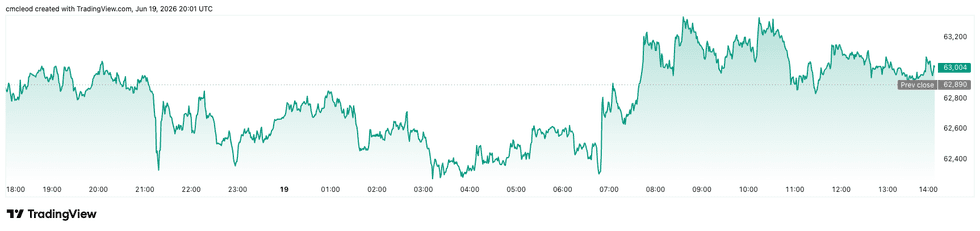
Chart via TradingView.
Bitcoin price performance, June 19, 2026.
Ether (ETH) was priced at US$1,701.7, trading 0.5 percent lower over the last 24 hours.
Altcoin price update
- XRP (XRP) was priced at US$1.13, trading 1.2 percent lower in 24 hours.
- Solana (SOL) was trading at US$68.97, 0.5 percent lower over the past 24 hours.
Today’s crypto news to know
Here’s a breakdown of today’s biggest news in the crypto and blockchain markets, including:
- US regulators propose verification rules for stablecoin issuers
- Ethereum exodus continues with co-director departure
- CME Group sues CFTC
- Franklin Templeton files for two new Bitcoin ETFs
- HIVE expands AI infrastructure, secures new contract
US regulators propose verification rules for stablecoin issuers
The US Department of the Treasury’s Financial Crimes Enforcement Network (FinCEN), alongside major federal banking regulators, has issued a joint proposed rule requiring permitted payment stablecoin issuers to maintain formal customer identification programs. Stablecoin issuers will be officially classified as financial institutions under the Bank Secrecy Act, legally binding them to rigorous anti-money laundering and identity verification procedures.
The compliance framework mandates that companies collect specific customer data before any account can be opened, including legal names, addresses, identification numbers and dates of birth or corporate formation.
Furthermore, issuers must establish written, risk-based protocols to verify client identities within a reasonable timeframe, utilizing both documentary and non-documentary verification methods.
For institutional accounts, the proposed rule dictates that stablecoin platforms must unmask and verify the identities of any specific individuals wielding authority or control over the funds.
The regulation also outlines strict guidelines for unverified customers, explicitly dictating when an account must be denied or closed, and outlining thresholds for filing mandatory suspicious activity reports.
The new regulatory push, which is now entering a 60 day public comment period, complements a separate FinCEN proposal that targets wider anti-money laundering obligations.
Ethereum exodus continues with co-director departure
The Ethereum Foundation’s leadership shakeup has intensified as co-director Hsiao-Wei Wang announced her immediate departure from the prominent digital asset organization. Wang’s sudden resignation follows a temporary sabbatical and comes closely on the heels of fellow co-director Tomasz Stańczak’s high-profile exit in February.
Facing a vacant leadership slot, interim co-director Bastian Aue will continue managing the internal transition, though the string of departures has fueled broader industry skepticism regarding the foundation’s structural stability.
Friction at the organization has been building for months. Researcher Dankrad Feist previously made public suggestions that a brand-new entity backed by US$1 billion in Ether funding is required to effectively “save Ethereum.”
Amid criticism regarding its proprietary token liquidations, the foundation recently implemented a transparent treasury protocol to stake roughly 70,000 ETH to capture acceptable yields.
CME Group sues CFTC
Exchange heavyweight CME Group (NASDAQ:CME) has filed a lawsuit against the Commodity Futures Trading Commission (CFTC) after federal regulators authorized prediction market Kalshi to offer crypto-style perpetual futures.
The complaint targets the CFTC’s decision to categorize Kalshi’s perpetual contracts as traditional futures rather than swaps. CME contends that this administrative classification allows the highly leveraged derivatives to bypass stricter federal rules and enter domestic markets under a significantly lighter regulatory oversight regime.
According to the lawsuit, the CFTC’s approval directly weakens critical risk management safeguards established after the 2008 financial crisis under the landmark Dodd-Frank Act.
Perpetual futures, which allow retail traders to maintain speculative market positions indefinitely without a fixed expiration date, have historically served as the cornerstone of unregulated offshore crypto platforms.
Franklin Templeton files for two new Bitcoin ETFs
Franklin Templeton has filed with the US Securities and Exchange Commission to launch two exchange-traded funds (ETFs) that will automatically reinvest corporate dividends into Bitcoin: the Franklin US Equity BTC DRIP Index ETF and the Franklin US Innovation BTC DRIP Index ETF.
These funds will start with 95 percent US stocks and 5 percent Bitcoin. Whenever the stocks pay dividends, the funds will automatically use every dollar to buy more Bitcoin exposure instead of paying it out.
They can do this through spot Bitcoin ETFs, Bitcoin futures, Bitcoin options or, in some cases, through a special offshore company. Every three months, the funds will check how much Bitcoin they hold.
If Bitcoin is above 5 percent, they will sell enough to bring it back down to 4.5 percent. Between those checks, Bitcoin can grow up to 20 percent on its own, but will be trimmed back at the next review.
The funds could start around September 1, 2026. Management fees haven’t been released yet.
Wealthsimple, Kalshi partner to launch prediction market in Canada
Wealthsimple has announced plans to launch Wealthsimple Predict, a new standalone app, in partnership with predictions exchange Kalshi, allowing investors to place bets on real-world events.
Contracts will cover financial markets, climate outcomes and economic indicators
The initiative, planned for the summer of 2026, will make Wealthsimple the first major Canadian fintech company to bring regulated prediction markets to retail investors.
“Prediction markets are the fastest-growing segment of global financial markets, letting traders turn an opinion into a position on the factors that shape our world — where inflation is headed, what happens to rates, or how the year unfolds. Until now, Canadians have had limited access,” said Brett Huneycutt, co-founder and chief product officer at Wealthsimple. “Wealthsimple Predict gives Canadians a clean, well-designed way to access these markets, with education and guardrails built in from day one.”
HIVE expands AI infrastructure, secures new contract
HIVE Digital Technologies (TSXV:HIVE,NASDAQ:HIVE) has purchased the 32 megawatt Big Boden data center in Sweden from Bodens Utvecklings. This move transitions HIVE from tenant to owner, strengthening an eight year regional partnership. The company plans to upgrade the site to Tier III standards, using NVIDIA (NASDAQ:NVDA) GPU architectures to support enterprise artificial intelligence (AI) and high-performance computing.
The acquisition aligns with HIVE’s strategy of expanding renewable-powered sovereign AI infrastructure while maintaining its community-focused operational model. This approach includes local initiatives like heat reuse and sponsorships, mirrored in its Canada and Paraguay operations.
In other news, the company’s subsidiary, BUZZ High Performance Computing, has secured a three year, US$220 million sovereign AI infrastructure contract with BCE (TSX:BCE,NYSE:BCE) and Cohere.
The partnership integrates Bell AI Fabric’s network, Cohere’s foundation models and BUZZ’s NVIDIA-accelerated cloud infrastructure. According to a press release, BUZZ will deploy 2,304 NVIDIA Grace Blackwell GPUs at Bell’s data center in Merritt, BC, using the NVIDIA GB200 NVL72 rack-scale system.
The initiative is designed to keep Canadian AI compute, data and models secure within national borders, directly supporting federal mandates for technological sovereignty.
The infrastructure is scheduled to go live between late 2026 and early 2027, and is expected to add approximately US$70 million in annual recurring revenue.
Don’t forget to follow us @INN_Technology for real-time news updates!
Securities Disclosure: I, Meagen Seatter, hold no direct investment interest in any company mentioned in this article.
Securities Disclosure: I, Giann Liguid, hold no direct investment interest in any company mentioned in this article.
5 Stocks Our Experts Predict Could Double In the Next Year
By submitting your email, you'll also get a free pivot & flow membership. A free daily market overview. You can unsubscribe at any time.