
Key Points
The S&P 500 (SNPINDEX: ^GSPC) is a powerhouse index, with decades of history surviving even the worst bear markets, crashes, and recessions.
It’s also a market-cap-weighted index, meaning larger stocks are weighted more heavily within the portfolio. That isn’t necessarily a bad thing, as large companies often add more stability to the index.
Where to invest $1,000 right now? Our analyst team just revealed what they believe are the 10 best stocks to buy right now, when you join Stock Advisor. See the stocks »
But for most of the past 25 years, the S&P 500 has been outperformed by its equal-weighted counterpart: the Invesco S&P 500 Equal Weight ETF (NYSEMKT: RSP). Here’s why history says this ETF could be poised for more growth in the years ahead.

Image source: Getty Images.
Why invest in an equal-weight S&P 500 ETF?
The Invesco S&P 500 Equal Weight ETF includes all of the stocks from the S&P 500. However, rather than ranking them by market cap, all holdings make up roughly the same percentage of the portfolio.
For example, Nvidia is the largest company in the S&P 500, accounting for nearly 8% of the index by market cap. But that stock accounts for only around 0.2% of the Equal Weight ETF’s portfolio, similar to every other company in the fund.
Historically, the Equal Weight ETF has proved to be more lucrative, outperforming the S&P 500 by a fairly wide margin for most of the past two decades.
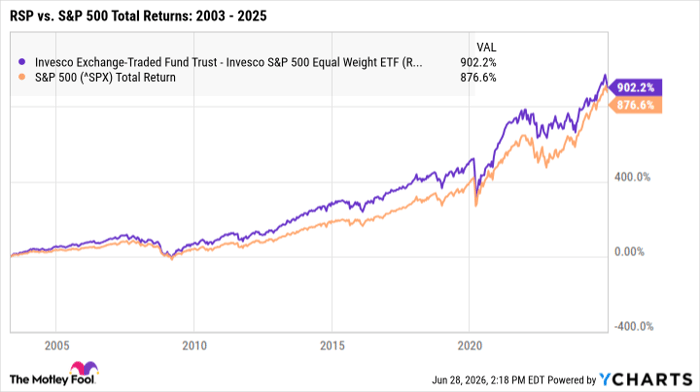
RSP Total Return Level data by YCharts
The index only began closing the gap over the last couple of years, as mega-cap tech companies have skyrocketed in value. When supercharged stocks like Nvidia make up a larger share of the S&P 500, they lift the entire index with their explosive growth.
Why this ETF is positioned for growth
The other side of that coin, though, is that a relatively small number of companies can also drag the entire index down.
The “Magnificent Seven” — comprising Apple, Alphabet, Amazon, Meta Platforms, Microsoft, Nvidia, and Tesla — together account for around one-third of the S&P 500’s total value. These stocks have been hit hard in recent weeks, as investors grow cautious around AI spending.
The Roundhill Magnificent Seven ETF, which holds only these seven stocks, has plunged by more than 13% in the past month. Excluding those seven stocks, though, the rest of the S&P 500 has surged by more than 2.5% over that period. But because the S&P 500 is so heavily weighted toward megacap tech, the overall index has still dipped.
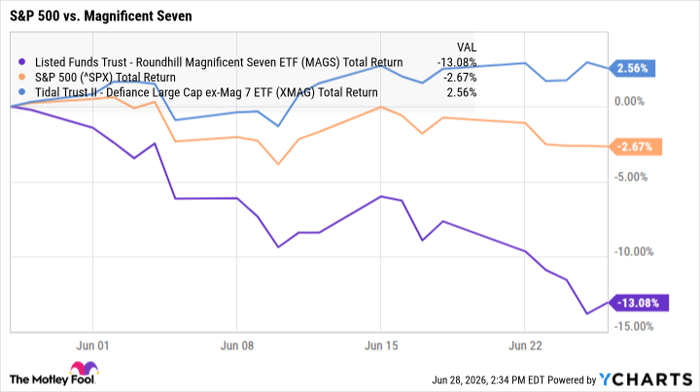
MAGS Total Return Level data by YCharts.
The Invesco S&P 500 Equal Weight ETF was designed for periods like this, particularly for investors unsettled by big tech’s influence on the S&P 500. While historical performance can’t predict future returns, this ETF could outpace the S&P 500 by an even wider margin if tech stocks continue their slump.
The S&P 500’s heavy concentration in tech stocks can leader to larger swings — for better or worse. For investors looking for more balanced exposure to the S&P 500 index, the Invesco S&P 500 Equal Weight ETF could be a safer (and perhaps more lucrative) choice.
Should you buy stock in Invesco S&P 500 Equal Weight ETF right now?
Before you buy stock in Invesco S&P 500 Equal Weight ETF, consider this:
The Motley Fool Stock Advisor analyst team just identified what they believe are the 10 best stocks for investors to buy now… and Invesco S&P 500 Equal Weight ETF wasn’t one of them. The 10 stocks that made the cut could produce monster returns in the coming years.
Consider when Netflix made this list on December 17, 2004… if you invested $1,000 at the time of our recommendation, you’d have $397,890!* Or when Nvidia made this list on April 15, 2005… if you invested $1,000 at the time of our recommendation, you’d have $1,196,664!*
Now, it’s worth noting Stock Advisor’s total average return is 902% — a market-crushing outperformance compared to 207% for the S&P 500. Don’t miss the latest top 10 list, available with Stock Advisor, and join an investing community built by individual investors for individual investors.
*Stock Advisor returns as of June 30, 2026.
Katie Brockman has no position in any of the stocks mentioned. The Motley Fool has positions in and recommends Alphabet, Amazon, Apple, Meta Platforms, Microsoft, Nvidia, and Tesla. The Motley Fool has a disclosure policy.
5 Stocks Our Experts Predict Could Double In the Next Year
By submitting your email, you'll also get a free pivot & flow membership. A free daily market overview. You can unsubscribe at any time.