
Alibaba‘s BABA digital commerce strategy is evolving into a more integrated, AI-enabled retail ecosystem that could support growth in fiscal 2027. Rather than relying solely on gross merchandise volume expansion, Alibaba is enhancing merchant productivity, consumer engagement and platform monetization across Taobao, Tmall and its instant commerce offerings. The company has also revamped its merchant development program by linking platform subsidies to merchants’ marketing spend, an initiative aimed at improving advertising penetration and long-term monetization. These efforts are already gaining traction, with customer management revenue (CMR) increasing 8% year over year on a like-for-like basis in the March quarter, while China E-commerce Group revenues rose 6% to RMB 122 billion.
Quick commerce has become a strategic extension of Alibaba’s broader retail platform rather than a standalone business. Order volume expanded 2.7 times year over year, supporting stronger growth at Freshippo and Tmall Supermarket while helping drive double-digit monthly active consumer additions for the Taobao app. At the same time, the integration of the Qwen app with Taobao, Tmall, Alipay, Amap and Fliggy is embedding AI-driven search, discovery and shopping assistance across Alibaba’s consumer ecosystem, creating additional opportunities to improve user engagement and purchase frequency over time.
These investments have weighed on near-term profitability, with Alibaba China E-commerce Group’s adjusted EBITA declining 40% year over year as spending on quick commerce, technology and user experience increased. However, improving fulfillment efficiency, higher average order values and stronger unit economics indicate that these investments are becoming more productive. If Alibaba continues translating higher consumer engagement into stronger merchant spending while improving the profitability of its quick commerce operations, its integrated digital commerce ecosystem could emerge as a meaningful catalyst for fiscal 2027 growth.
How Alibaba Stacks Up Against PDD and JD ?
Alibaba faces intense competition from PDD Holdings PDD and JD.com JD, both of which continue to invest in strengthening their digital commerce ecosystems.
PDD Holdings has expanded its value-driven marketplace through AI-enabled merchant tools and Temu’s international growth, while JD.com leverages its self-operated logistics network and omnichannel retail capabilities to enhance fulfillment speed and customer experience. Unlike PDD Holdings and JD.com, Alibaba operates a broader ecosystem spanning Taobao, Tmall, Taobao Instant Commerce, Ele.me, AliExpress and Alibaba.com, creating multiple consumer touchpoints across domestic and cross-border commerce. As PDD Holdings and JD.com intensify competition, Alibaba’s AI-powered ecosystem, merchant monetization initiatives and integrated commerce platform could provide a differentiated long-term growth advantage.
BABA’s Share Price Performance, Valuation & Estimates
BABA shares have plunged 34.8% in the year-to-date period, underperforming the Zacks Internet – Commerce industry and the Zacks Retail-Wholesale sector, which have declined 6.6% and 1.9%, respectively.
BABA’s YTD Price Performance
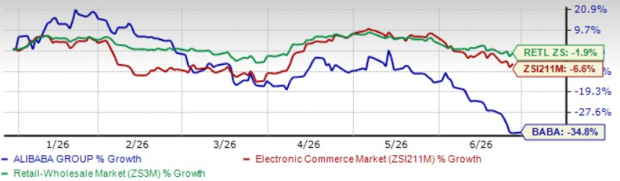
Image Source: Zacks Investment Research
From a valuation standpoint, BABA stock is currently trading at a trailing 12-month Price/Earnings ratio of 30.23X compared with the industry’s 28.31X. BABA has a Value Score of D.
BABA’s Valuation

Image Source: Zacks Investment Research
The Zacks Consensus Estimate for fiscal 2027 earnings is pegged at $7.29 per share, down by a penny over the past 30 days, indicating a 87.4% year-over-year increase.
Alibaba Group Holding Limited Price and Consensus

Alibaba Group Holding Limited price-consensus-chart | Alibaba Group Holding Limited Quote
Alibaba currently has a Zacks Rank #3 (Hold). You can see the complete list of today’s Zacks #1 Rank (Strong Buy) stocks here.
Radical New Technology Could Hand Investors Huge Gains
Quantum Computing is the next technological revolution, and it could be even more advanced than AI.
While some believed the technology was years away, it is already present and moving fast. Large hyperscalers, such as Microsoft, Google, Amazon, Oracle, and even Meta and Tesla, are scrambling to integrate quantum computing into their infrastructure.
Senior Stock Strategist Kevin Cook reveals 7 carefully selected stocks poised to dominate the quantum computing landscape in his report, Beyond AI: The Quantum Leap in Computing Power.
Kevin was among the early experts who recognized NVIDIA’s enormous potential back in 2016. Now, he has keyed in on what could be “the next big thing” in quantum computing supremacy. Today, you have a rare chance to position your portfolio at the forefront of this opportunity.
Alibaba Group Holding Limited (BABA) : Free Stock Analysis Report
JD.com, Inc. (JD) : Free Stock Analysis Report
PDD Holdings Inc. Sponsored ADR (PDD) : Free Stock Analysis Report
This article originally published on Zacks Investment Research (zacks.com).
5 Stocks Our Experts Predict Could Double In the Next Year
By submitting your email, you'll also get a free pivot & flow membership. A free daily market overview. You can unsubscribe at any time.