
Key Points
If you asked me at the start of the year how I would rank Advanced Micro Devices (NASDAQ: AMD), Broadcom (NASDAQ: AVGO), and Nvidia (NASDAQ: NVDA) in terms of potential stock performance, I would have put Nvidia at the top, Broadcom in the middle, and AMD in last place. So far in 2026, my projection that Broadcom would be in the middle has panned out, but AMD has been a massive winner while Nvidia has been a loser.
There’s still a lot of time left in 2026, but which one of these three artificial intelligence (AI)-related stocks is the best buy now?
Missed Nvidia in 2009? This Rare Signal Is Flashing Again. In 2009, a “Double Down” signal flashed for a little-known chipmaker called Nvidia. For the first time in years, that same “Total Conviction” signal is flashing for a company 1/100th the size of Nvidia. Continue »
Let’s take a look at this trio and rerank them for the rest of 2026 and into 2027.

Image source: Getty Images.
AMD and Nvidia are competing in the same field
All three of these stocks are being heavily spurred on by massive AI spending. AMD and Nvidia approach this problem from the same perspective, as each offers graphics processing units (GPUs) that excel in computing scenarios with variable, complex workloads. However, Nvidia’s products have downright dominated the field to date, and it holds a commanding lead in the data center space.
Broadcom is taking a completely different approach. Instead of a broad-purpose computing unit like a GPU, it has partnered directly with a handful of AI hyperscalers to design a custom AI chip tailored to the workloads each firm sees. This creates a chip that often offers better cost-performance than GPU-based computing, driving its rising popularity.
Broadcom expects major growth next year as new clients launch their custom AI chips. Currently, Broadcom’s major customer is Alphabet, with its Tensor Processing Units (TPUs). However, Broadcom is also making custom AI chips for Meta Platforms, Anthropic, and OpenAI, and production for those chips is scheduled to ramp up late this year and into next.
So, which of these is the best horse to back from a business approach? I’m still bearish on AMD, as it has a major uphill battle to win space in data centers when so many ecosystems have already been developed around Nvidia’s. Between Nvidia and Broadcom, it’s tough because many companies will stick with GPU-based training for its flexibility. Still, custom AI chips will likely become quite popular over the next few years as AI hyperscalers look to optimize their spending. As a result, I’m giving this one to Nvidia and Broadcom as a tie.
Winners: Nvidia and Broadcom
Nvidia is still dominating the growth game
From a growth standpoint, Nvidia still stands alone at the top, growing far faster than the other two.
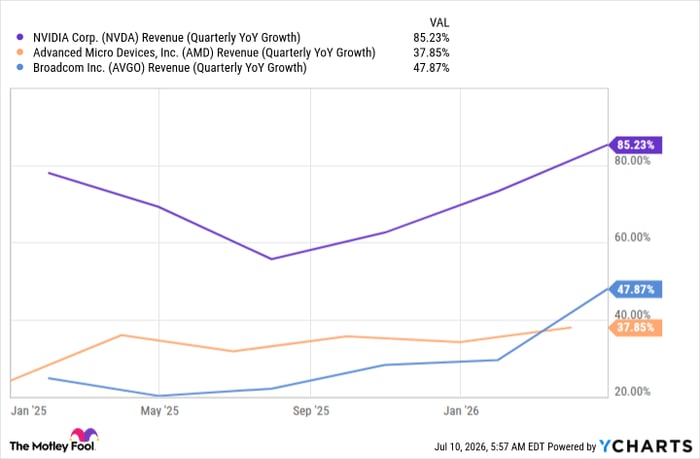
Data by YCharts.
Looking ahead, the market still expects Nvidia to maintain its lead for the full fiscal year, though Broadcom is starting to close the gap.
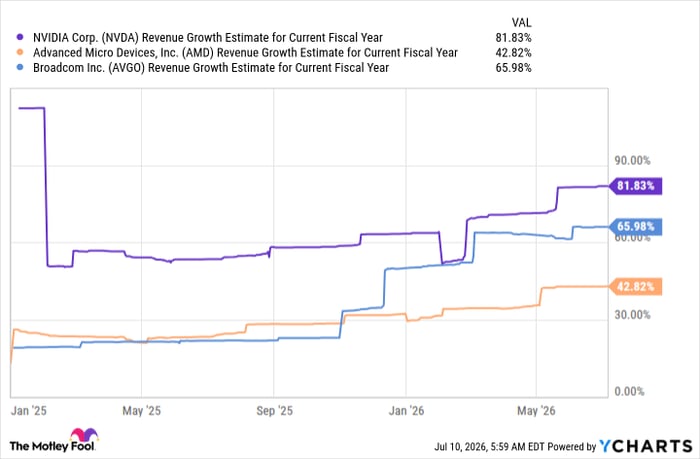
Data by YCharts.
AMD is still well behind Nvidia, and while I think Broadcom is still a strong pick, Nvidia will likely retain its rapid-growth title for some time.
Winner: Nvidia
AMD’s stock is outrageously expensive
Lastly, let’s look at valuation. Because all three of these stocks are rapidly growing, the best way to value them is by using earnings projections. For the current fiscal year, AMD’s stock is far more expensive than either Broadcom’s or Nvidia’s. Furthermore, Broadcom is also more than 50% more expensive than Nvidia’s.
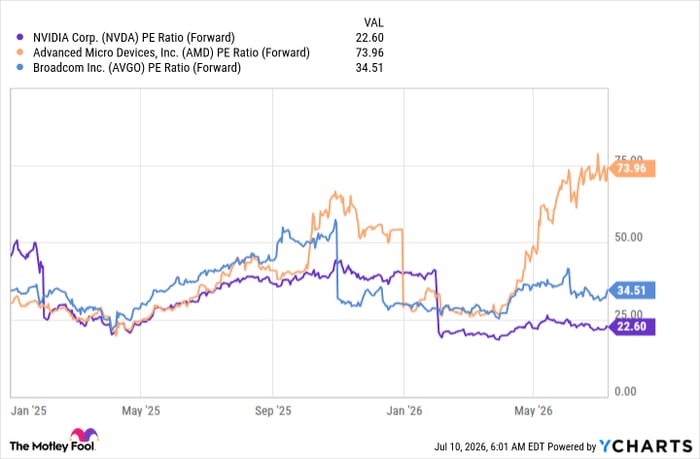
Data by YCharts.
If we use next fiscal year’s projections, the trend remains the same: Nvidia’s stock looks dirt cheap compared to the other two.
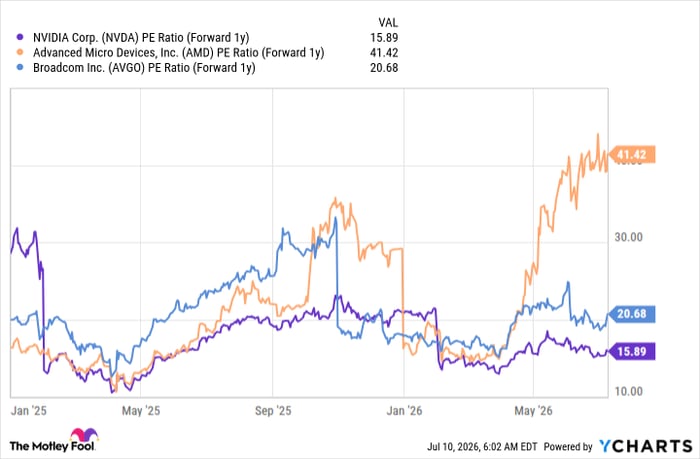
Data by YCharts.
Clearly, Nvidia is the winner here as well.
Winner: Nvidia
Investors should sell AMD shares for Nvidia shares
I think the biggest takeaway here is that AMD’s 2026 rally has likely gotten ahead of itself, and investors are discounting Nvidia far too much, as its display is being far more successful than AMD’s. Broadcom is still a solid stock pick with strong growth head, but it just isn’t as good a deal as Nvidia right now.
Should you buy stock in Nvidia right now?
Before you buy stock in Nvidia, consider this:
The Motley Fool Stock Advisor analyst team just identified what they believe are the 10 best stocks for investors to buy now… and Nvidia wasn’t one of them. The 10 stocks that made the cut could produce monster returns in the coming years.
Consider when Netflix made this list on December 17, 2004… if you invested $1,000 at the time of our recommendation, you’d have $395,679!* Or when Nvidia made this list on April 15, 2005… if you invested $1,000 at the time of our recommendation, you’d have $1,294,805!*
Now, it’s worth noting Stock Advisor’s total average return is 929% — a market-crushing outperformance compared to 211% for the S&P 500. Don’t miss the latest top 10 list, available with Stock Advisor, and join an investing community built by individual investors for individual investors.
*Stock Advisor returns as of July 12, 2026.
Keithen Drury has positions in Alphabet, Broadcom, Meta Platforms, and Nvidia. The Motley Fool has positions in and recommends Advanced Micro Devices, Alphabet, Broadcom, Meta Platforms, and Nvidia. The Motley Fool has a disclosure policy.
5 Stocks Our Experts Predict Could Double In the Next Year
By submitting your email, you'll also get a free pivot & flow membership. A free daily market overview. You can unsubscribe at any time.