
Tom Yeung here with your Sunday Digest.
When NASA began its space missions in the early 1960s, little thought was given to the food on board. Most missions only lasted a couple of hours, so astronauts were sent into orbit with just a few tubes of bland applesauce.
The problems began to surface with L. Gordon Cooper’s 1963 Mercury flight, which lasted 34 hours – an American record. The sandwiches for lunch crumbled, the pot roast spilled in the cockpit, and Cooper would skip breakfast entirely, according to flight transcripts.
By 1969, the food situation was dire. That year, Donald Arabian, head of NASA’s Mission Evaluation Room, was asked to evaluate a four-day food supply for the Apollo program. Arabian called himself a “human garbage can.” But even he could barely stomach the freeze-dried food.
And so, NASA looked for help.
One of the first outfits they asked was the U.S. Army’s Natick Laboratories – a group well versed in military-rations technology. Army researchers then hired Whirlpool Corp. (WHR), the appliance company, to help package these dinners.
Soon, other companies got involved. Pillsbury made chocolate energy bars… Kellogg’s did breakfast… Nestle SA (NSRGY) supplied coffee… and Whirlpool itself would end up creating the meals for the Apollo 11 moon mission.
It turns out the brightest minds at NASA still needed help making food for space travel.
The same concept is now proving true in artificial intelligence. Trillion-dollar companies with budgets the size of small countries are pushing the technological envelope, but also turning to outside vendors for help.
Nowhere is this clearer than at Elon Musk’s companies. His AI empire is vast: He owns data through Grok and X, computing power through xAI, connectivity through SpaceX Technologies Corp. (SPCX), robots through Tesla Inc. (TSLA), and more.
Yet, his firms are some of the biggest customers of other AI firms, such as Oracle Corp. (ORCL), Nvidia Corp. (NVDA), and Honeywell International Inc. (HON). That creates an opportunity. Three weeks ago, I wrote about how InvestorPlace Senior Analyst Luke Lango mapped out the supply chains of Musk’s companies and identified eight overlooked gems in his recent free Vertical AI Event broadcast.
One of his recommendations I revealed in that update – Credo Technology Group Holding Ltd. (CRDO) – has already risen 22%.
I’ve been allowed to reveal one more of his eight recommendations today. But this is the last one I’ll be able to tell you about. To find the rest, click here to see his free presentation.
Riding the AI Space Race
The potential Elon Musk supplier from Luke I want to tell you about here is essentially three things rolled into one.
1. A space company. It was founded in 2020 as a rollup of “heritage” space suppliers. These legacy firms made a wide range of products, including the solar panels on the International Space Station and digital sensors on the Mars Perseverance rover.
2. A defense company. In 2025, this company acquired Edge Autonomy, a defense-tech firm. Edge now generates 53% of total revenues, specializing in unmanned aircraft, ground defense systems, and backup power solutions.
3. A story stock. Shares of this space-and-defense firm have traded wildly in recent years. The stock sank below $5 in November 2025 when a major federal government shutdown put the defense industry on pause. It then surged past $25 the following May on enthusiasm over SpaceX’s IPO.
Here is a graph from our partners at TradeSmith to illustrate how volatile shares have been.
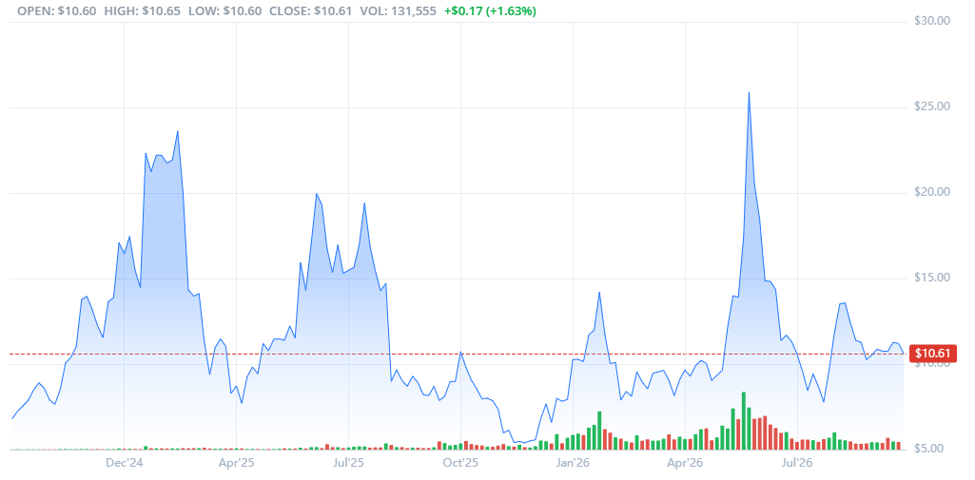
Stock price. Oct 2024-present
These stories are now converging in three ways to create a “must own” company for the long run, and are why Luke has selected Redwire Corp. (RDW) as a potential Elon Musk supplier stock to buy.
Three Rockets, One Launchpad
The first convergence is positioning. By acquiring Edge, Redwire has become a one-stop shop for space-based defense systems.
Earlier this year, Redwire was put onto SHIELD – the U.S. government’s official $151 billion master contracting vehicle to build America’s “Golden Dome” missile defense system. The Congressional Budget Office believes the government could eventually spend as much as $1.2 trillion by the end of the project. That’s over four times more than NASA spent on the Apollo missions, adjusted for inflation.
Redwire enters this program with an unusually strong hand. It can provide unmanned aerial systems, advanced sensors, maneuverable spacecraft, and the modeling-and-simulation tools needed to guide drones to their target from space. The company might not be able to cater space food, but it does enter the Golden Dome project with an unusually relevant product portfolio for the job ahead.
The second convergence is financial.
The 2025 acquisition of Edge Autonomy transformed Redwire from an indebted, slow-growing legacy rollup into a faster-growing diversified player. Management used this fact to raise $565 million in equity in six months following the Edge acquisition, retiring 75% of total debt. That’s something the pre-Edge Redwire could never have done.
Redwire is additionally using its profitable defense segment to bankroll its unprofitable R&D bets in space technologies. Supporters call it “synergies,” while critics might say it’s “cross-funding.” In either case, it’s allowing the combined firm to develop the tech it will need in an increasingly AI-powered world of space and defense. More on that later.
The final convergence is optical.
Since May, shares of Redwire have fallen 60% as retail interest in space stocks has faded. The stock is now trading at roughly $10, even though the company is better off today than it was during the summer. Redwire reported strong second-quarter earnings on August 5 and has since won multiple new contracts. For instance, Redwire was selected in September for Space Systems Command’s $980 million NITE-STAR contract, a program to build space simulators for wartime conditions.
That means Redwire’s stock has become more attractive, even as retail investors have fled. A $15 near-term target price gives a 40% upside.
Datacenters With a View
That 40% upside should expand in the coming years as Redwire moves into AI data centers… in space.
I know this sounds like science fiction. But it’s real. And that’s because the AI Revolution is running into a very earthly problem:
Electricity.
Roughly 40% of all data-center projects are getting pushed from 2026 into 2027, and grid hookups are now the No. 1 reason for projects getting scrapped.
AI is also running into other domestic problems, such as the lack of available land, and environmental permitting issues, and community pushback. There are now more than 400 state and local moratoriums in effect on new data centers.
Moving data centers into space solves these problems at once. In the right orbit, a solar panel can receive sunlight almost all the time. There are no clouds, no nighttime, and no atmosphere to dilute the sun’s rays. Google estimates that a solar panel in orbit can be up to eight times more productive than one on the ground.
There’s also no land to buy, and no neighbors to annoy.
That’s why the biggest names in tech are taking the idea seriously. Last November, Google unveiled Project Suncatcher to test its AI chips in orbit; the prototype was launched into space earlier this week. Nvidia-backed Starcloud has already put an H100 GPU into space. And SpaceX’s own IPO prospectus suggests it is already designing AI satellites to work in orbit.
Of course, putting a data center in orbit is hard. A huge solar array must fold into a rocket and then unfurl reliably in space. The computing hardware needs to vent enormous amounts of heat in a vacuum, where there’s no air to carry it away. And all that data has to get back down to Earth somehow.
Those are exactly the problems Redwire has spent years solving.
Start with power. Redwire’s solar arrays already power the International Space Station and have been used on other critical projects. NASA itself credits the design’s compact packaging, low mass, and reliable deployment.
Then there’s communications. Redwire has delivered more than 200 flight antennas, and in August it announced a new investment in next-generation phased-array technology. Rocket Lab Corp. (RKLB) has already chosen Redwire to supply antennas, proof that other spacecraft builders are willing to buy its hardware.
Finally, we have orbital computing itself. On September 30, Redwire signed an agreement with Sophia Space. The plan is to pair Sophia’s orbital computing designs with Redwire’s space infrastructure products – another early step to making data centers in space.
That brings us back to Elon Musk.
SpaceX often likes to build things itself. It manufactures its own rockets, engines, satellites, and space suits.
But just like NASA in the 1960s, even SpaceX admits there are times it needs outside help. Its rocket’s communication chips are from STMicroelectronics NV (STM), the parachutes are from Airborne Systems, and even its launchpads were acquired from NASA.
We expect SpaceX to rely on Redwire for parts of its AI data-center dreams as well. Space-ready solar panels and heat vents are specialized products that are often worth buying from someone else. So are the communications systems that link satellites together.
Now, Redwire doesn’t need a SpaceX contract for shares to go higher. It already has the three other convergences working for it. But if Musk’s empire expands its business with RDW, that would be serious upside for a stock that’s still 60% off its highs.
Finding More Winners of the AI Revolution
The trouble with buying AI companies is that the hype doesn’t always match the reality. Startups have every incentive to oversell themselves, and many investors have proven quite bad at telling the truth from marketing.
Customer testimonials often help. If a company like Google is buying chips from a startup, there’s a good chance the technology works well.
However, Luke Lango goes a step further. He identifies eight firms in Elon’s “Vertical AI Blueprint” that are already running multimillion-dollar businesses. And they’re all like Credo and Redwire – working on and selling next-gen technologies instead of trying to please investors by inserting the word “AI” everywhere.
And so, I urge you to watch Luke’s Vertical AI Event, where he talks more about those eight firms creating the tools for Musk’s AI empire and the four areas investors should watch as he considers where the money could flow next.
Click here to check it out.
As NASA learned in the 1960s, even the world’s top engineers need help from time to time.
Until next week,
Thomas Yeung, CFA
Market Analyst, InvestorPlace
5 Stocks Our Experts Predict Could Double In the Next Year
By submitting your email, you'll also get a free pivot & flow membership. A free daily market overview. You can unsubscribe at any time.