
Key Points
-
Management raised its 2026 delivery outlook to 65,000 to 70,000 vehicles.
-
Rivian began delivering the R2, its new lower-priced SUV, in June.
-
Software and services produced a 42% gross margin in the second quarter.
- 10 stocks we like better than Rivian Automotive ›
As of this writing, Rivian (NASDAQ: RIVN) stock sits at about $16, giving the company a market value of about $23 billion. For that price, investors get an electric vehicle maker that will deliver perhaps 70,000 vehicles this year, still loses money on them at the gross level, and just started shipping the product its whole investment case rests on.
That last part is why the next three years matter so much. The R2, a smaller and more affordable SUV than Rivian’s first models, began reaching customers on June 9. Whether the stock is higher or lower in 2029 comes down to how many R2s the company builds — and what each one earns.
Missed Nvidia in 2009? This Rare Signal Is Flashing Again. In 2009, a “Double Down” signal flashed for a little-known chipmaker called Nvidia. For the first time in years, that same “Total Conviction” signal is flashing for a company 1/100th the size of Nvidia. Continue »
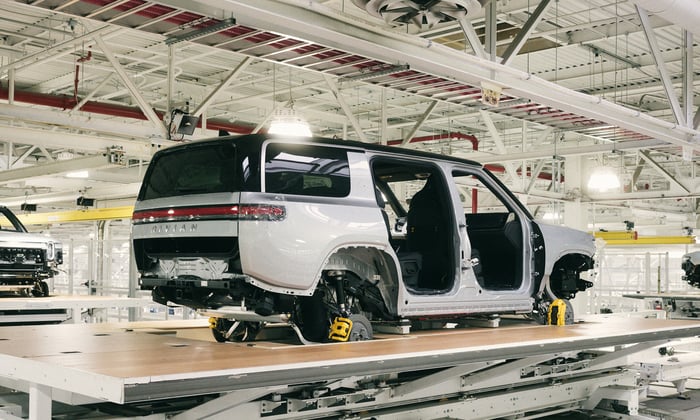
Image source: Rivian.
The business the R2 is supposed to change
Rivian’s second-quarter report, released July 30, showed a company heading into the ramp with momentum. Revenue rose 27% year over year to $1.66 billion, and deliveries climbed 14% to 12,194 vehicles, well above the 9,000 to 11,000 management had forecast. That outperformance led the company to raise its full-year delivery outlook to 65,000 to 70,000 vehicles, from 62,000 to 67,000.
The profit picture is improving, too, though from a low base. Consolidated gross profit came in at $179 million in the second quarter, an 11% margin.
However, the automotive segment itself ran a $36 million gross loss. That’s a dramatic improvement from the $335 million automotive gross loss of a year earlier — helped in part by regulatory credit revenue — and management said the quarter absorbed approximately $100 million of incremental costs from ramping R2 production. Strip those out, and the vehicle business would have been modestly profitable at the gross level.
What actually carried the quarter was software and services. The segment generated $515 million in revenue, up 37% year over year, with $215 million of gross profit, a 42% margin.
The commercial side keeps scaling, too. Amazon now has more than 40,000 Rivian electric delivery vans on the road.
Still, Rivian remains deeply unprofitable overall. The company expects a full-year adjusted EBITDA (earnings before interest, taxes, depreciation, and amortization) loss of $1.8 billion to $2.0 billion, and it plans capital spending of $1.7 billion to $1.8 billion this year. A $5.3 billion pile of cash and short-term investments at the end of June, since topped up by a stock sale in early July, is what funds the ramp.
The math three years out
So, what could the business look like in 2029?
Rivian says its two U.S. plants (Normal, Illinois, today, plus a Georgia site backed by a Department of Energy loan of up to $4.5 billion) support capacity growth to as much as 515,000 vehicles per year in later phases. I wouldn’t model anything close to full utilization by 2029. But a path from about 70,000 deliveries to somewhere near 200,000 over three years relies on expansion the company is already building, not on new ideas.
Suppose that volume arrives. At an assumed blended price of around $60,000 (R2s at the lower end of the lineup, R1s and commercial vans above it), 200,000 vehicles would produce automotive revenue near $12 billion. Add a software and services business compounding at anything like its current 37% rate, and total revenue could reach $17 billion or so, against about $6.6 billion annualized today.
On that math, today’s market value works out to about 1.4 times that future revenue — not a demanding multiple, if the vehicles earn money by then.
That “if” is, to me, the entire investment case. A carmaker that still loses money on its vehicles at 70,000 units has to prove that volume fixes the problem. Management’s case is that shared production lines in Normal spread fixed costs across more vehicles as R2 scales. The second half of this year offers the first evidence either way.
The downside is just as easy to sketch, though. EV demand can wobble, and ramps can slip. A company running an adjusted EBITDA loss near $2 billion a year has less room for error than its cash balance suggests — and Rivian priced a 75 million-share stock offering as recently as early July.
My answer to the three-year question: The stock could be meaningfully higher if R2 volume shows up with a real gross margin attached, because the current valuation arguably isn’t pricing in much success. But this remains a speculative stock, not a proven business. I’d treat it accordingly — and only with money I could afford to see shrink.
Should you buy stock in Rivian Automotive right now?
Before you buy stock in Rivian Automotive, consider this:
The Motley Fool Stock Advisor analyst team just identified what they believe are the 10 best stocks for investors to buy now… and Rivian Automotive wasn’t one of them. The 10 stocks that made the cut could produce monster returns in the coming years.
Consider when Netflix made this list on December 17, 2004… if you invested $1,000 at the time of our recommendation, you’d have $399,832!* Or when Nvidia made this list on April 15, 2005… if you invested $1,000 at the time of our recommendation, you’d have $1,374,595!*
Now, it’s worth noting Stock Advisor’s total average return is 968% — a market-crushing outperformance compared to 215% for the S&P 500. Don’t miss the latest top 10 list, available with Stock Advisor, and join an investing community built by individual investors for individual investors.
*Stock Advisor returns as of August 9, 2026.
Daniel Sparks and his clients do not have positions in any of the stocks mentioned. The Motley Fool has positions in and recommends Amazon. The Motley Fool has a disclosure policy.
5 Stocks Our Experts Predict Could Double In the Next Year
By submitting your email, you'll also get a free pivot & flow membership. A free daily market overview. You can unsubscribe at any time.