
Key Points
SpaceX will go public soon, and the hype has been building since it filed to go public in early April.
Elon Musk’s rocket, satellite, and AI company just released its S-1 prospectus, the detailed report required of companies entering the market.
Will AI create the world’s first trillionaire? Our team just released a report on the one little-known company, called an “Indispensable Monopoly” providing the critical technology Nvidia and Intel both need. Continue »
SpaceX is reportedly targeting a $2 trillion valuation, which would make it one of the most valuable companies in the world. However, SpaceX is much smaller than any of the elite businesses that have a valuation of $2 trillion or more.
2025 revenue reached $18.7 billion, but the company is unprofitable with a generally accepted accounting principles (GAAP) operating loss of $2.6 billion last year, and its losses have widened since its merger with xAI, the company that owns the Grok chatbot and the X social media site, earlier this year.
Like Tesla (NASDAQ: TSLA), SpaceX’s value isn’t in its current financials, but its future potential, as investors have bought into Elon Musk’s vision of colonizing Mars, and, according to SpaceX’s mission statement, “build the systems and technologies necessary to make life multiplanetary…”
Its business extends beyond space exploration with Starlink, its satellite internet business, and xAI, its AI business, and the company believes it has an addressable market of $28.5 trillion, nearly the size of U.S. GDP, which it calls “the largest actionable total addressable market in human history.”
Most of that value is in “enterprise applications,” which are part of its AI segment, and an opportunity it values at $22.7 trillion. That includes Grok Voice, a real-time speech engine; an image and video generation system, Imagine; and Macrohard, an agentic AI platform that it’s developing with Tesla that is “designed to be capable of fully emulating digital workflows and augmenting human operation of computers.”
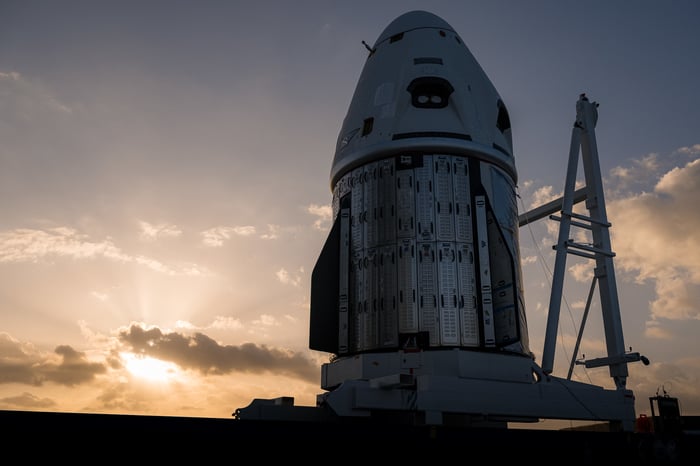
Image source: SpaceX.
The problem with TAM
Tech companies, especially ones going public, often tout their total addressable market as a selling point for the business, but the statistic isn’t necessarily meaningful.
It only tells you how large the market that the company competes in is, and in this case, that forecast is heavily based on future projections.
The TAM often acts as a sleight-of-hand, encouraging investors to look at the size of the market opportunity, rather than the performance of the business, but the size of the TAM isn’t particularly helpful for assessing a business. All it tells you is how big the company could get. However, investors should also remember that typically, the larger the market, the more competitors there will be.
There are also plenty of examples of companies that debuted with large addressable markets that seemed promising before fading. Stitch Fix, the online styling service, touted a $500 billion addressable market at one point. Archer Aviation, a development-stage maker of electric vertical takeoff and landing (eVTOL) vehicles, once estimated a future total addressable market of $9 trillion. That hasn’t helped either of those companies grow.
What it means for SpaceX
Investors shouldn’t be distracted by SpaceX’s TAM projection, which seems to stretch the limits of reality, considering that it’s only slightly below the U.S. GDP of $32.4 trillion.
I think SpaceX is significantly overvalued at a price tag of around $2 trillion, but its bold mission to settle the moon and Mars, and its technologies like reusable rockets and Starlink satellite internet, make it a unique company, and it’s understandable why it has attracted investors.
If the company can fulfill some of those goals, it will likely deserve a trillion-dollar valuation, but investors shouldn’t get caught up with the addressable market figure. It’s mostly a meaningless concept for SpaceX at this point, as its revenue of less than 0.1% of its addressable market shows.
Don’t miss this second chance at a potentially lucrative opportunity
Ever feel like you missed the boat in buying the most successful stocks? Then you’ll want to hear this.
On rare occasions, our expert team of analysts issues a “Double Down” stock recommendation for companies that they think are about to pop. If you’re worried you’ve already missed your chance to invest, now is the best time to buy before it’s too late. And the numbers speak for themselves:
- Nvidia: if you invested $1,000 when we doubled down in 2009, you’d have $569,379!*
- Apple: if you invested $1,000 when we doubled down in 2008, you’d have $58,129!*
- Netflix: if you invested $1,000 when we doubled down in 2004, you’d have $481,589!*
Right now, we’re issuing “Double Down” alerts for three incredible companies, available when you join Stock Advisor, and there may not be another chance like this anytime soon.
*Stock Advisor returns as of May 23, 2026.
Jeremy Bowman has no position in any of the stocks mentioned. The Motley Fool has positions in and recommends Tesla. The Motley Fool recommends Stitch Fix. The Motley Fool has a disclosure policy.
5 Stocks Our Experts Predict Could Double In the Next Year
By submitting your email, you'll also get a free pivot & flow membership. A free daily market overview. You can unsubscribe at any time.