
Key Points
Amazon (NASDAQ:AMZN) has been one of the key players in the artificial intelligence (AI) revolution thanks to Amazon Web Services (AWS). Customers turn to cloud providers like AWS for access to AI chips, large language models, and more — and this has translated into tremendous growth for AWS and Amazon overall.
But one element has weighed on the minds of investors, and at certain points, demand for Amazon stock. Investors have questioned the depth and pace of the AI infrastructure build-out, wondering if the revenue opportunity down the road will make this kind of spending worthwhile — or if players will be left with too much capacity.
Missed AI’s “Act 1”? Act 2 Could Be 15x Bigger. Most investors think they missed the AI boat because they didn’t buy Nvidia in 2005. But according to our analysts, we’re only at the end of “Act 1″—the R&D phase. “Act 2” is the global rollout. Continue »
Tech giants have committed to spending more than $700 billion this year alone to ramp up infrastructure. And Amazon, during its latest earnings report, increased its capital expenditure forecast for this year to $220 billion from $200 billion.
Here’s why this level of spending shouldn’t worry investors.

Image source: Getty Images.
How Amazon is winning in AI
Before we consider Amazon’s latest capex plans, let’s take a closer look at the company’s AI story so far. Amazon is winning in AI because it is a user, a developer, and a seller of AI products and services. The company’s e-commerce unit benefits from the technology as it applies AI in areas such as fulfillment to gain efficiency and bring down the cost to serve.
But Amazon’s biggest AI victories are through its AWS business. As the world’s No. 1 cloud service provider, AWS is perfectly positioned to capture a great deal of AI demand. Companies that already use AWS for other non-AI services often turn to this cloud giant for AI too, as it’s convenient to keep all business with one provider.
AWS has clearly been scoring a win as Amazon says it has been seeing high demand in non-AI and AI business. A few figures to illustrate this: In the recent quarter, AWS’ generative AI and custom chip annual revenue run rates each reached more than $25 billion. And the total AWS annual run rate hit $169 billion.
Now, let’s consider the capital spending levels that have worried some investors. Amazon chief Andy Jassy compared the current spending trend with the spending trend in the early days of cloud computing. He said Amazon made the same moves, but over a longer time period. Today, with demand accelerating faster, Amazon must make the investment over a shorter period.
“Strong financial returns”
“At this level of spend and higher, we have clear line of sight to strong financial returns,” Jassy said during the earnings call.
Here’s how: The company’s data centers involve investment two years before servers are put in and monetization can begin. But these data centers last for at least 30 years, supporting five to six generations of servers. The servers are the money-makers, generating revenue as soon as they’re plugged in.
Amazon purchases the servers and networking equipment only a few months before installation, so the company has a clear picture of demand. If the demand isn’t there, Amazon won’t buy the server.
The servers break even in just under three years, and they can be used for up to six, allowing for plenty of time to generate profit. Meanwhile, AI contracts have spanned at least five years, offering Amazon earnings visibility.
Jassy said that, with this in mind, Amazon sees the margins and returns in the AI business following the pattern the company saw in its core cloud business — and even delivering results faster.
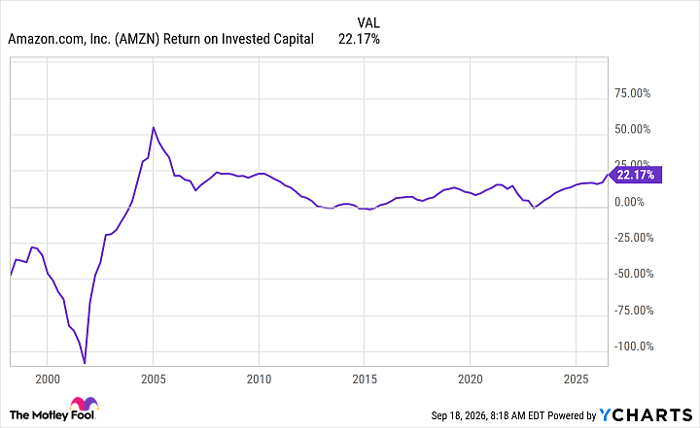
AMZN Return on Invested Capital data by YCharts
All of this offers us a clear idea of the capital spending plan for AI and how this translates into profit. And these details, along with the tremendous level of demand AI companies are seeing, and the idea that AI real-world use is just beginning, should offer investors some confidence about the future. That’s why Amazon’s $220 billion in capex this year shouldn’t worry shareholders who aim to hold onto the stock for the long term: The tech giant and its shareholders may greatly benefit as this cycle plays out.
Don’t miss this second chance at a potentially lucrative opportunity
Ever feel like you missed the boat in buying the most successful stocks? Then you’ll want to hear this.
On rare occasions, our expert team of analysts issues a “Double Down” stock recommendation for companies that they think are about to pop. If you’re worried you’ve already missed your chance to invest, now is the best time to buy before it’s too late. And the numbers speak for themselves:
- Nvidia: if you invested $1,000 when we doubled down in 2009, you’d have $577,856!*
- Apple: if you invested $1,000 when we doubled down in 2008, you’d have $64,119!*
- Netflix: if you invested $1,000 when we doubled down in 2004, you’d have $387,158!*
Right now, we’re issuing “Double Down” alerts for three incredible companies, available when you join Stock Advisor, and there may not be another chance like this anytime soon.
*Stock Advisor returns as of September 21, 2026.
Adria Cimino has positions in Amazon. The Motley Fool has positions in and recommends Amazon. The Motley Fool has a disclosure policy.
5 Stocks Our Experts Predict Could Double In the Next Year
By submitting your email, you'll also get a free pivot & flow membership. A free daily market overview. You can unsubscribe at any time.