
The market has finally realized that not all AI stocks are created equal. But in the rush to debate platform winners, investors are still missing the bigger opportunity.
The conversation around ’s long-term dominance intensified after Google’s Gemini announcement—and escalated further with reports that may explore using Google’s TPUs. As a result, performance has started to sharply diverge between the OpenAI Complex—with , Nvidia, and as core suppliers—and the Google Complex, with positioned as a critical partner.
But the area receiving far less attention is the broader AI value chain. In our view, these infrastructure providers stand to become the biggest beneficiaries of AI adoption and offer the most attractive risk/reward profile.
We break down this overlooked opportunity in detail in this report.
Our research digest is designed to keep you on the cutting edge of investments in data infrastructure, software, and cybersecurity.
This content is not intended as investment advice. Companies mentioned may or may not be holdings in our funds.
Platform Wars
The narrative around AI leadership has shifted rapidly in recent weeks. What began as a simple question about Nvidia’s staying power has turned into a broader debate about the future of AI infrastructure.
From January through September, every AI stock moved together: Nvidia, AMD, Google, Oracle, all trading in lockstep.
The market treated AI as one giant bet.
But by October, everything changed.
Three distinct groups emerged:
- The OpenAI Complex
- The Google Complex
- The Value Chain
We dive deeper into each one
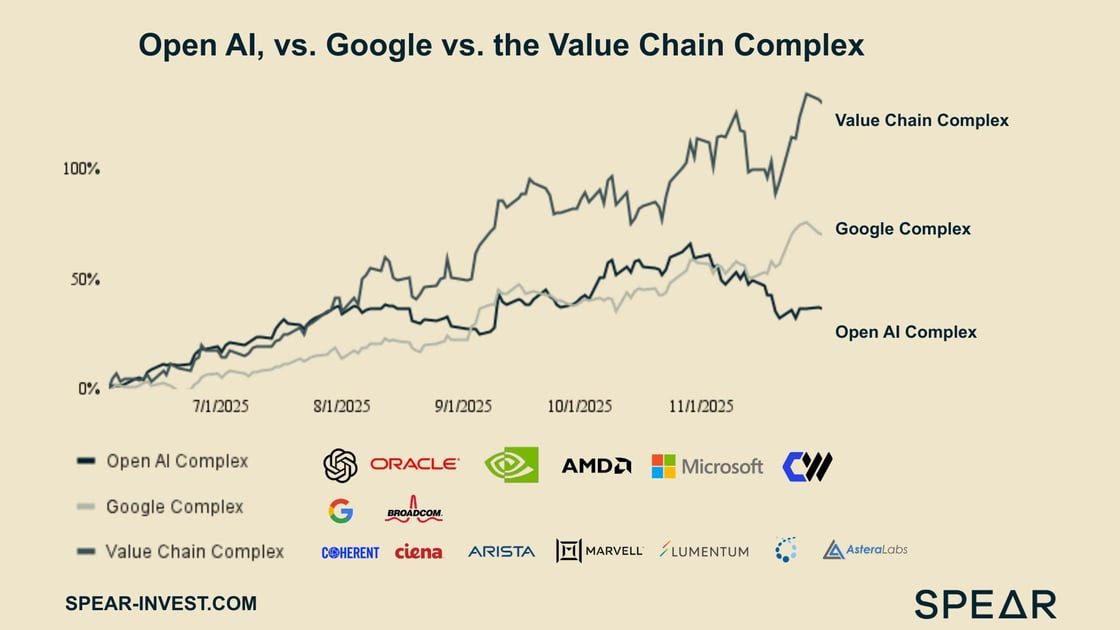 Open AI vs. Google
1. The OpenAI Complex: Cracks Under the Surface
Who’s in this group?
Nvidia, AMD, , Oracle, CoreWeave.
This ecosystem is tethered to OpenAI’s massive infrastructure ambitions—ambitions that come with equally massive questions.
OpenAI has signaled a $1.3 trillion capex future. But here’s the issue: that spend isn’t backed by profits or clear unit economics. The downstream effects are already showing up.
Stress points are emerging:
- Oracle needs ~$90B of new debt over the next three years to keep pace with capex and negative free cash flow.
- OpenAI accounts for two-thirds of Oracle’s backlog—a concentration risk the credit market hates.
- CDS spreads are widening for both Oracle and CoreWeave, signaling rising credit stress.
This group is no longer trading like a sure thing. It’s trading like a question mark.
2. The Google Complex: A Credible Challenger to Nvidia
Who’s here?
Google & Broadcom.
This ecosystem is gaining momentum fast as TPUs continue carving out real market share, particularly in recommender systems. This is a specific application that Google uses internally to suggest the best ads and content, and can be used more widely in other recomender use cases (think Meta, Tik Tok).
Google’s TPU demand is accelerating.
Broadcom is the custom manufacturer behind these accelerators.
But there’s a catch:
TPUs outperform Nvidia only in specific workloads. They’re not yet a general-purpose threat which is wehre Nvidia wins.
Expect volatility here—big wins, but also big questions.
3. The Value Chain: The Quiet Winners Behind Everyone Else’s Drama
Companies: Technology, , , , , , Technology.
While the platforms fight for headlines, the companies that supply every platform are quietly posting blowout numbers.
- Credo: 272% YoY growth—electrical cable demand is exploding.
- Astera Labs: Triple-digit growth as scale-up components become essential for every cloud provider.
- Marvell: Visibility all the way through 2026/27 with projected +25% and +40% YoY growth.
- Coherent & Lumentum: Optics demand is kicking into its next major cycle.
These companies are under-promising and consistently beating expectations—the opposite of the platform layer.
Why?
Because they don’t care who wins the AI platform war.
They supply everyone.
 The Mispriced Risk: Platforms vs. Infrastructure
The market keeps asking the wrong question:
“Will OpenAI or Google win?”
But platform investing carries binary risk:
GPUs fall behind → valuation collapses
Model adoption slows → multiple compresses
One missed product cycle → years of premium disappear
The value chain doesn’t have this problem.
If:
- Google wins → they need Lumentum optics
- AWS wins → they need Astera components
- Nvidia keeps winning → they need Credo cables
The Bottom Line
As the AI market matures, volatility in the OpenAI and Google ecosystems will only increase. Expectations will swing. Narratives will shift. Predictions will multiply.
The best opportunities may not be the platforms fighting for dominance—but the value chain that wins no matter what.
5 Stocks Our Experts Predict Could Double In the Next Year
By submitting your email, you'll also get a free pivot & flow membership. A free daily market overview. You can unsubscribe at any time.